New Hampshire gets a lot of attention from people planning retirement. No income tax. No sales tax. Mountains, lakes, and the ocean within an easy drive. Boston about an hour away.
All of that is true. It is also only half the picture. Property taxes are high, winters are long, and some of the tax breaks retirees count on don’t start the day you arrive.
College Bound Movers has been moving people into and around New Hampshire since 1991 from our home base in Merrimack. Here is what prospective retirees should know before they commit, with the numbers checked against state and town sources.
Why Retirees Look at New Hampshire
You won’t be alone here. New Hampshire is one of the oldest states in the country. In 2023 its median age was 43.4, tied with Vermont for second-oldest behind Maine, and about 20.8% of residents were 65 or older, according to the New Hampshire Fiscal Policy Institute.
That matters in practical ways. Towns are used to serving older residents, and 55+ communities are common across the southern part of the state. For retirees coming from Massachusetts, children and grandchildren often stay within an hour’s drive.
If you’re still deciding whether the state fits your life in general, start with our guide to the reasons people move to New Hampshire. This article focuses on retirement.
How New Hampshire Taxes Retirement Income
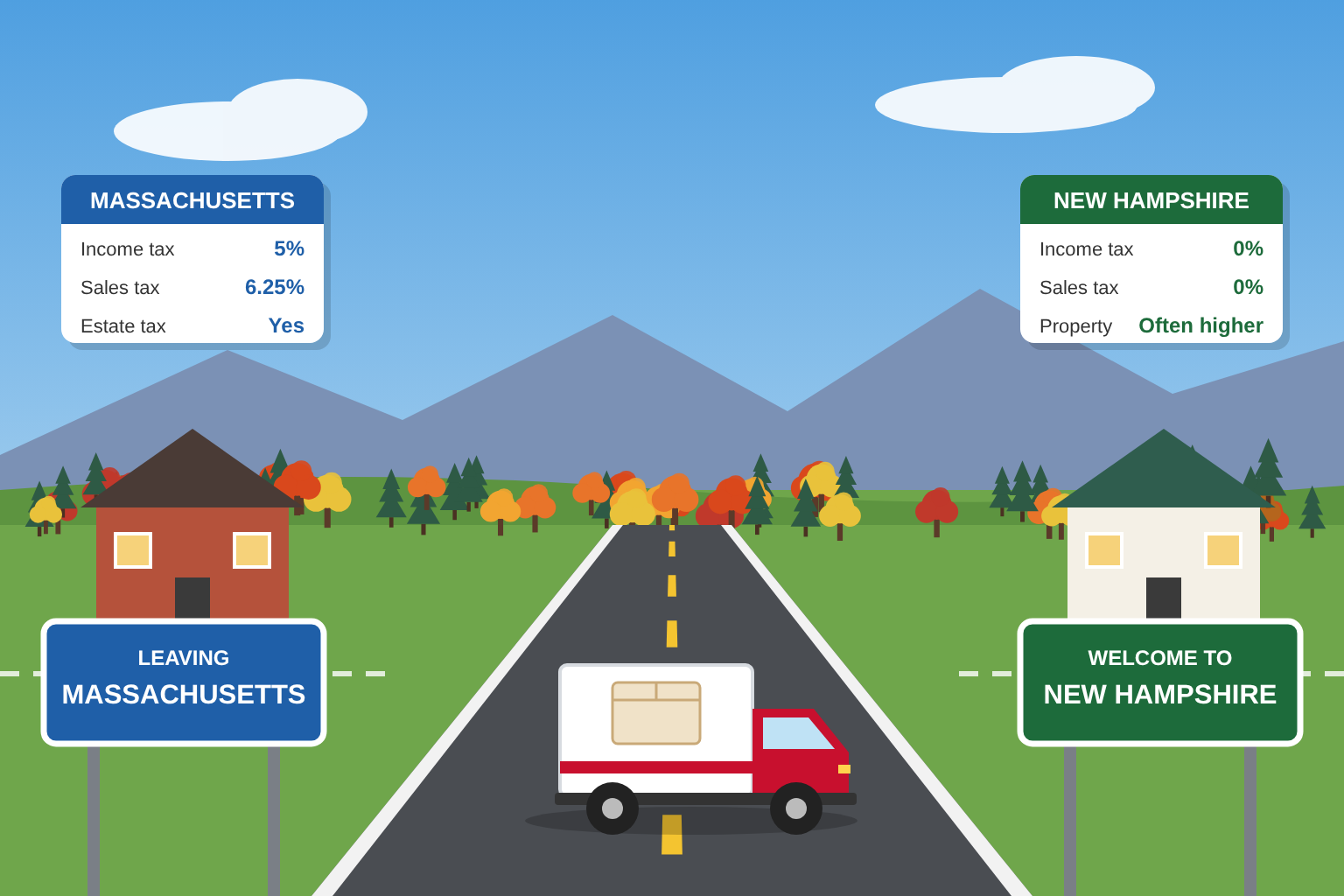
Short answer: it doesn’t.
New Hampshire has never taxed wages. Its last individual income tax, the Interest and Dividends Tax, was repealed for tax periods beginning on or after January 1, 2025. The rate had already dropped to 3% for 2024.
For retirees, that means no state income tax on:
- Social Security benefits
- Pensions
- IRA and 401(k) withdrawals
- Interest and dividends
- Capital gains
- Part-time or consulting income
There is also no general sales tax. Furniture for the new place, a car, a washer and dryer: no sales tax at the register.
What New Hampshire Does Tax
The state still has to raise money. These are the taxes retirees will notice:
- Meals and rooms tax: 8.5% on restaurant meals, hotel stays, and car rentals.
- Real estate transfer tax: $0.75 per $100 of the sale price, charged to both the buyer and the seller. On a $580,000 home, that is $4,350 for each side.
- Property tax: The big one. More on that below.
One caution if you’re leaving Massachusetts or another income-tax state. The year you move, you’ll likely file a part-year resident return in your old state. Talk to a tax professional about timing, especially if you plan to sell investments or take a large retirement distribution around your move date.
Property Taxes: The Real Cost of Retiring Here
New Hampshire pays for local government and schools mostly through property taxes. Its effective property tax rate consistently ranks among the highest in the country.
Every tax bill combines four rates: municipal, county, state education, and local education. Totals vary widely by town. Nashua’s 2025 rate, set by the New Hampshire Department of Revenue Administration, is $16.83 per $1,000 of assessed value. A home assessed at $500,000 in Nashua would carry a tax bill of about $8,415 a year.
Two things to know before you compare towns:
- Tax rates alone can mislead. A town with a low rate and high assessments can cost as much as a town with a high rate and low assessments. Ask the listing agent or the town assessor for the actual tax bill on the specific home.
- Rates change every year. Nashua’s rate rose from $15.90 in 2024 to $16.83 in 2025. Budget for increases.
For a retiree on a fixed income, property tax is often the line item that decides whether a town works.
The Elderly Exemption Has a 3-Year Waiting Period
New Hampshire law (RSA 72:39-a) lets towns reduce the assessed value of a home for owners 65 and older. Most people know that much. Fewer know the catch for newcomers.
To qualify, you generally must:
- Be 65 or older by April 1 of the tax year
- Have lived in New Hampshire for at least 3 consecutive years before April 1
- Own the home and live in it as your primary residence
- Meet the town’s income and asset limits
That residency rule means a retiree who moves here at 66 won’t see the exemption until about age 69. Build that gap into your budget.
The other big variable is that each town sets its own exemption amounts and limits. Compare two towns in our service area, based on their published exemption documents:
- Milford: $83,000 off assessed value for ages 65 to 74, $124,000 for ages 75 to 79, and $200,500 for 80 and older. Income limits of $40,500 single and $46,000 married. Asset limit of $125,000, not counting the home.
- Windham: $200,000 off assessed value for ages 65 to 74, $225,000 for ages 75 to 79, and the full assessed value at 80 and older. Income limit of $65,000 gross for married couples.
Same state law. Very different results. Check the assessor’s page for every town on your shortlist. Many towns set an April 15 application deadline, and some, including Milford, require you to requalify every other year.
Low and Moderate Income Homeowners Property Tax Relief
The state runs a separate program that refunds part of the state education portion of your property tax. Homeowners with total household income of $37,000 or less (single) or $47,000 or less (married or head of household) can apply. You must own the home and live in it as of April 1 of the year you claim.
Applications go to the Department of Revenue Administration between May 1 and June 30, using Form DP-8 or the state’s online portal. The eligibility rules don’t include the elderly exemption’s 3-year residency requirement.
Housing Costs for Retirees
Southern New Hampshire is not cheap, and prices are still climbing. According to New Hampshire REALTORS® data, the statewide median single-family home sold for $580,000 in July 2026, up 5.5% from a year earlier. The median condo sold for $429,950.
By county:
- Rockingham County (Seacoast and the Massachusetts border towns): the median crossed $700,000 for the first time in July 2026.
- Hillsborough County (Nashua, Manchester, Merrimack, Bedford): $582,000 in June 2026.
- Strafford County (Dover and nearby towns): $582,500 in July 2026, up 17.1%, the fastest growth in the state.
- Merrimack County (Concord area): $535,000 in June 2026.
Statewide supply sat at 2.7 months in July 2026. That is still a seller’s market.
What this means if you’re retiring here:
- Downsizing doesn’t always free up cash. A smaller home or condo in a desirable town can cost close to what a larger home sells for elsewhere. Run the numbers on the actual homes you’d buy, not on statewide averages.
- Condos and 55+ communities trade yard work for monthly fees. Ask exactly what the association covers, including plowing, roofs, and exteriors, and how much fees have risen in recent years.
- Selling and buying rarely line up. A gap between closings is common in a tight market. Short-term storage can hold your belongings until the new place is ready.
Healthcare Access
For most retirees, healthcare is the deciding factor after cost. Access in New Hampshire is strongest in the south and thins out as you head north.
Our service area sits close to the state’s main hospitals:
- Nashua: Southern New Hampshire Medical Center and St. Joseph Hospital
- Manchester: Elliot Hospital and Catholic Medical Center
- Concord: Concord Hospital
- Derry: Parkland Medical Center
- Seacoast: Portsmouth Regional Hospital, Wentworth-Douglass Hospital in Dover, and Exeter Hospital
For complex specialty care, many residents travel to Dartmouth Hitchcock Medical Center in Lebanon or to Boston. From the Nashua and Salem areas, Boston is often the shorter drive.
Hospital ownership is also shifting. HCA Healthcare completed its purchase of Catholic Medical Center in early 2025 and now owns four of the state’s 26 acute care hospitals. Ownership changes can affect which insurance networks a hospital and its doctors accept. Before you settle on a town, confirm that your Medicare coverage, and especially a Medicare Advantage plan, includes the doctors and hospitals nearby.
For free Medicare help, contact ServiceLink, New Hampshire’s Aging and Disability Resource Center network. Its Medicare specialists are trained through the State Health Insurance Assistance Program (SHIP), and there are offices in Manchester, Nashua, and across the state.
Climate: Plan for Real Winters
Four seasons are part of the appeal. Winter is the one that tests retirees.
Concord sits in the middle of our service area. Based on National Weather Service normals for 1991 to 2020, its average January high is about 32°F and the average low is about 13°F. The city averages roughly 165 nights a year at or below freezing and about 17 inches of snow in January alone.
What that means day to day:
- Snow removal is a recurring cost or chore. Budget for a plow service, or choose a condo where the association handles it.
- Ice is a real fall risk. Look for a home with an attached garage, a short walkway, and few exterior steps.
- Heating is a major expense. Ask sellers for a year of heating bills and find out what fuel the home uses.
- Splitting the year is common. If you plan to spend winters somewhere warmer, a lock-and-leave condo is easier to manage from afar than a house.
The Seacoast runs a bit milder than inland towns, but it is still a New England winter. Our guide to moving to New England with the right mindset covers the adjustment.
Where Retirees Settle in Southern New Hampshire
The right town depends on what matters most to you: family, healthcare, taxes, or walkability. Here is how the main areas we serve compare.
Nashua, Merrimack, Amherst, and Milford
This corridor puts you close to family in northern Massachusetts. Nashua has two hospitals, a walkable downtown, and city services. Merrimack, Amherst, and Milford offer quieter, more suburban and small-town settings with Nashua a short drive away. Our guide to Nashua covers the city in more detail.
Manchester, Bedford, Hooksett, and Concord
Manchester is the state’s largest city, with about 116,400 residents in 2024. It has two hospitals, the Currier Museum of Art, and Manchester-Boston Regional Airport, which makes visiting family easier. Bedford and Hooksett offer more space just outside the city. Concord, the state capital, is anchored by Concord Hospital. For a closer look at the city, read what moving to Manchester is like.
The Seacoast: Portsmouth, Dover, and Hampton
Portsmouth has the state’s most walkable downtown, plus ocean access, restaurants, and a busy arts scene. It also has the highest home prices, with Rockingham County now over a $700,000 median. Dover has Wentworth-Douglass Hospital and Amtrak Downeaster service to Boston, though Strafford County prices are rising fastest in the state. Hampton puts you near the beach and Exeter Hospital.
Border Towns: Salem, Windham, Londonderry, and Derry
These towns offer the shortest drive to the Merrimack Valley and the Boston area. Derry has Parkland Medical Center. Salem and Londonderry give quick access to I-93. Windham’s elderly exemption, covered above, is far larger than Milford’s, but read its income and asset rules before you count on it.
Is Retiring in New Hampshire Right for You?
New Hampshire tends to fit retirees who:
- Have meaningful income from investments, pensions, or IRA withdrawals that another state would tax
- Want to stay close to family in Massachusetts or elsewhere in New England
- Enjoy four seasons and don’t mind planning around winter
- Are comfortable driving, since public transit is limited outside the larger cities
Think harder if you:
- Live mostly on Social Security. Most states don’t tax Social Security, so New Hampshire’s income tax advantage is smaller for you, while property taxes still apply.
- Are coming from a state with no income tax, such as Florida. You may not save on income tax and could pay more in property tax.
- Need frequent specialist care and want to live north of Concord.
- Don’t want to drive in snow. Even with good plowing, winter driving is part of life here.
Your First 60 Days as a New Hampshire Resident
A few New Hampshire-specific steps to handle early:
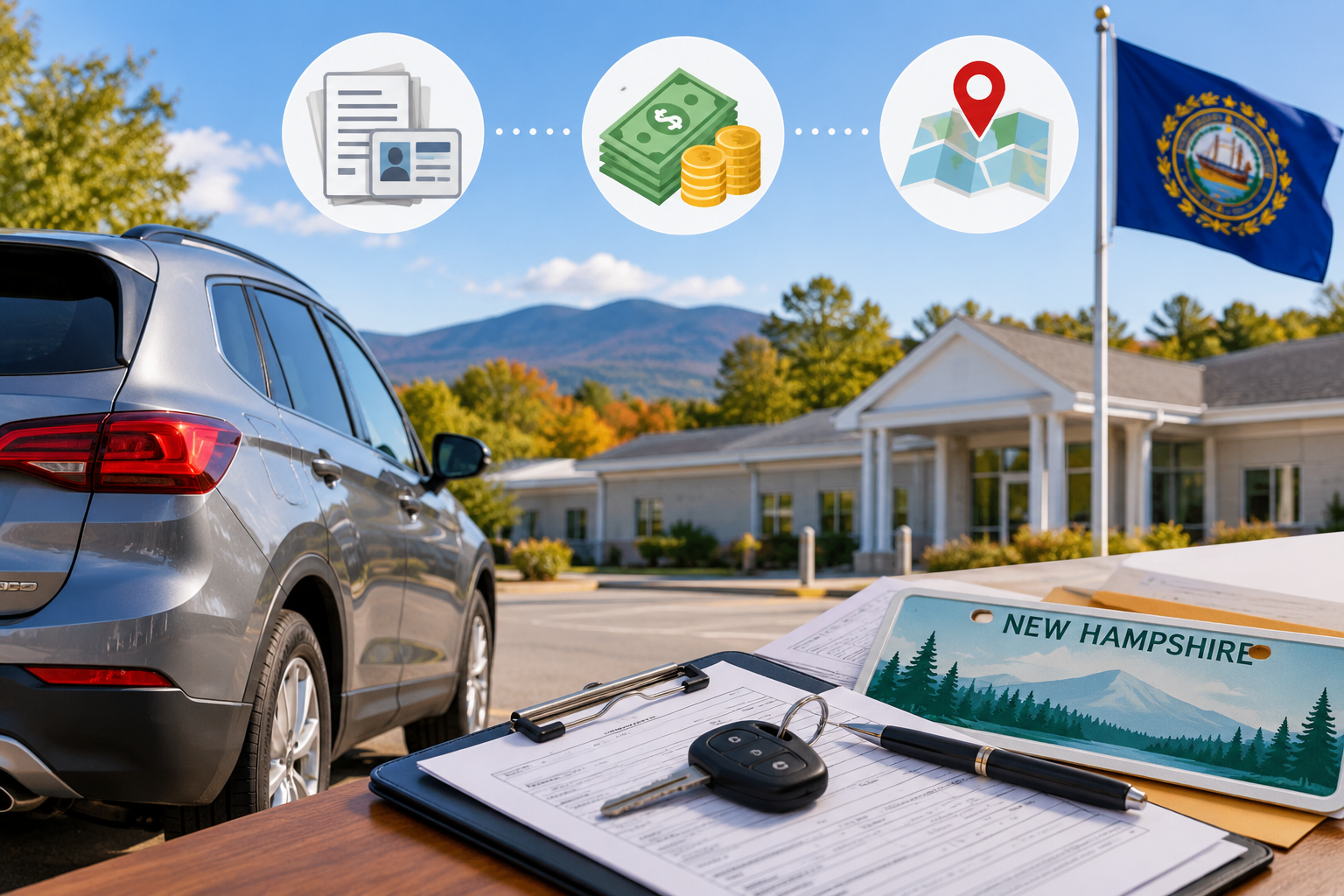
- Start at your town or city clerk. In New Hampshire, vehicle registration and proof of residency start at the town clerk’s office, not the DMV. Bring your deed or lease, a utility bill, and your out-of-state vehicle titles.
- Get a New Hampshire driver’s license within 60 days. Out-of-state licenses can be transferred by appointment at a DMV office.
- Write down your residency date. It starts the 3-year clock for the elderly exemption.
- Mark the property tax calendar. Elderly exemption applications are usually due by April 15. Low and moderate income relief applications run May 1 to June 30.
- Review your Medicare coverage. A move to a new state can change which plans are available to you. ServiceLink can help you compare options.
Planning Your Retirement Move With College Bound Movers
Most retirement moves are downsizing moves. Decades of belongings have to be sorted, packed, and fit into a smaller space, often on a tight timeline between two closings.
Here is how we help:
- Downsizing: Our room-by-room downsizing plan walks through what to keep, sell, donate, and toss.
- Packing: Our packing services cover a full home, a few rooms, or a job you started and ran out of time to finish. For china and heirlooms, see our fragile packing tips.
- Storage: Portable storage through INBOX and self-storage through Trophy Storage help when your move happens in stages.
- Moving from out of state: Our long-distance movers handle relocations into New Hampshire from across the East Coast and beyond.
- Senior community moves: We coordinate directly with community move-in coordinators. If you’re helping a parent, read our guide to moving an aging parent.
- Moving within New Hampshire: Our local movers serve towns across southern New Hampshire and the Merrimack Valley in Massachusetts.
Ready to plan your retirement move? Get a free moving estimate or call us at (603) 882-6683.
Frequently Asked Questions
Does New Hampshire tax Social Security or pension income?
No. New Hampshire does not tax Social Security, pensions, IRA or 401(k) withdrawals, or wages. The Interest and Dividends Tax was repealed for tax periods beginning on or after January 1, 2025, so interest, dividends, and capital gains are no longer taxed at the state level either.
Is New Hampshire a good place to retire?
It can be, especially for retirees with investment or pension income, family in New England, and a tolerance for winter. The main trade-offs are high property taxes, rising home prices, car-dependent living, and fewer specialists in the northern part of the state.
How much are property taxes in New Hampshire?
It depends on the town. Nashua’s 2025 rate is $16.83 per $1,000 of assessed value, which works out to about $8,415 a year on a home assessed at $500,000. Always ask for the actual tax bill on a specific home, since assessment levels vary from town to town.
Do seniors get a property tax break in New Hampshire?
Yes, through the elderly exemption, but only after you’ve lived in New Hampshire for 3 consecutive years before April 1 of the tax year. You must also be 65 or older and meet your town’s income and asset limits. Exemption amounts vary widely by town.
Where do retirees live in southern New Hampshire?
Popular choices include the Nashua and Merrimack area for proximity to Massachusetts, Manchester and Concord for hospitals and city services, the Seacoast for walkability and ocean access, and border towns like Salem and Windham for the shortest drive to the Boston area.
How long do I have to get a New Hampshire driver’s license after moving?
You have 60 days after establishing residency to get a New Hampshire driver’s license. Start at your town or city clerk to establish residency and register your vehicles.
Can College Bound Movers help me move to New Hampshire from another state?
Yes. We handle local moves within New Hampshire and Massachusetts and long-distance moves into the state, along with packing, storage, and labor-only services. Request a free estimate to get started.