New Hampshire vs. Massachusetts Taxes at a Glance
We move people across the NH and MA border every week, in both directions. The question we hear most on estimate calls: will I actually save on taxes?
The honest answer is that it depends on three things. Where you earn your paycheck. What kind of income you have. And which house, in which town, you buy. New Hampshire is not tax-free. It shifts the bill from income and sales to property and a few targeted taxes. Massachusetts does the opposite.
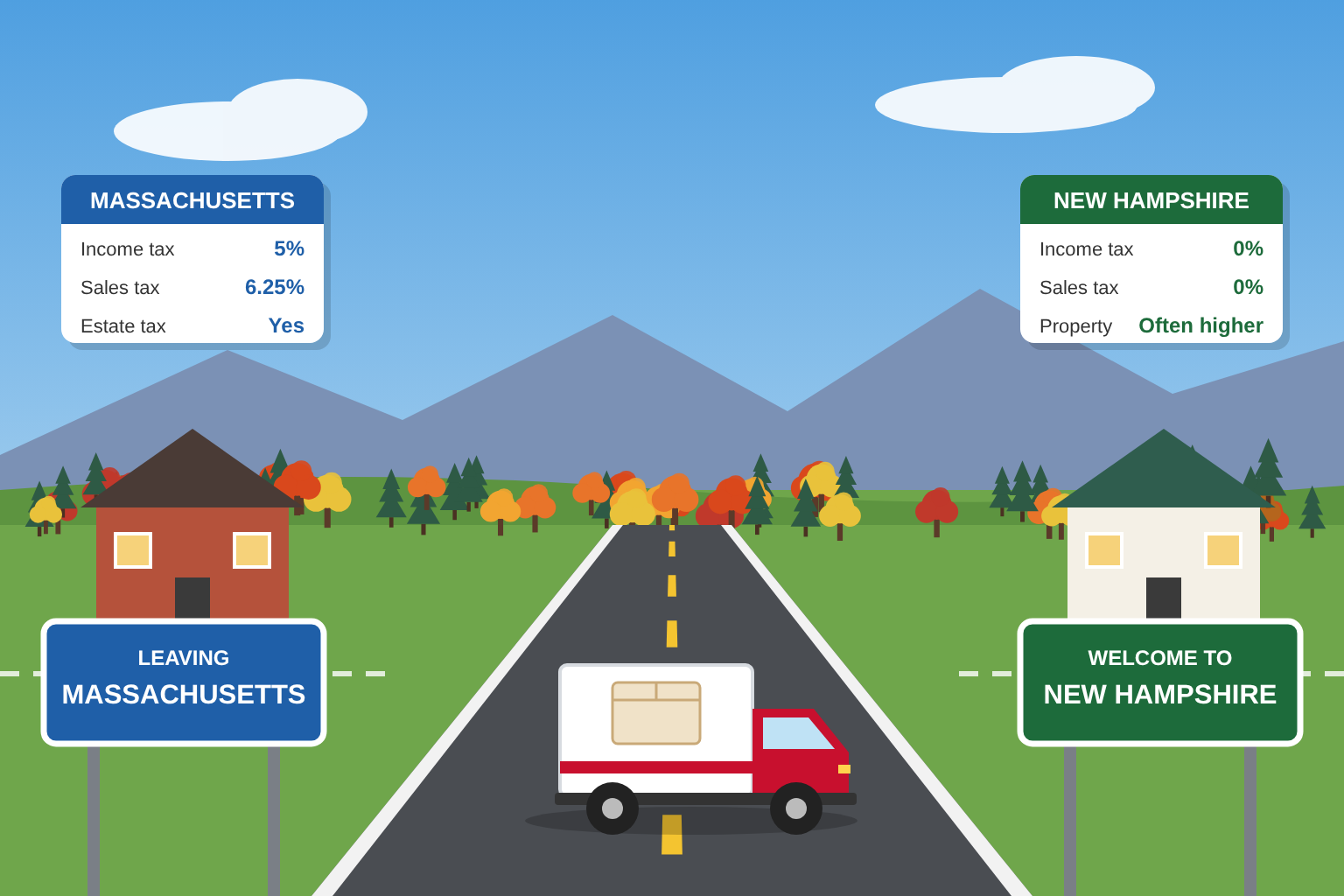
Here is the side-by-side. Rates are for tax year 2026 unless a different year is noted.
| Tax | Massachusetts | New Hampshire |
|---|---|---|
| Income tax on wages | 5% flat, plus a 4% surtax on taxable income over $1,107,750 | None |
| Interest and dividends | 5% | None. The Interest and Dividends Tax was repealed for tax periods starting January 1, 2025 |
| Short-term capital gains | 8.5% | None |
| General sales tax | 6.25%. Groceries exempt. Clothing exempt up to $175 per item | None |
| Restaurant meals | 6.25% state, plus up to 0.75% local option | 8.5% Meals and Rooms (Rentals) Tax |
| Property tax | Set by each city and town. FY2026 statewide average single-family bill: $8,113 | Set by each town. Rates often look higher, but compare actual bills, not rates |
| Social Security | Not taxed | Not taxed |
| Private pensions, 401(k), IRA withdrawals | Taxed at 5% | Not taxed |
| Estate tax | Applies to estates valued at $2 million or more, rates from 0.8% to 16% | None |
| Real estate transfer tax | Deeds excise of $2.28 per $500 of sale price | $0.75 per $100, charged to both buyer and seller |
| Buying a car | 6.25% sales or use tax, plus a yearly excise of $25 per $1,000 of value | No sales tax. Town permit fee at each registration, based on list price and model year |
| Business taxes on the self-employed | Income flows through to your personal 5% rate | Business Profits Tax (7.5%) and Business Enterprise Tax (0.55%) above filing thresholds |
This is general information, not tax advice. Your own numbers can land very differently, so run them with a CPA before you sign a purchase and sale.
Income Tax: The Biggest Difference
Income tax is where the real gap sits. For most households it is the largest single line in the comparison.
Massachusetts
Massachusetts taxes most income at a flat 5%. That covers wages, interest, dividends, and long-term capital gains. Short-term capital gains are taxed at 8.5%.
On top of that, the 4% surtax (often called the millionaires tax) applies to taxable income above $1,107,750 for tax year 2026. The threshold adjusts every year. It was $1,083,150 for 2025.
In practice, every $10,000 of Massachusetts taxable income costs about $500 in state income tax. A household with $150,000 of taxable income pays roughly $7,500 a year.
New Hampshire
New Hampshire has never taxed wages or salaries. It did tax interest and dividends, at 3% for 2024 on amounts above $2,400 for single filers and $4,800 for joint filers. That tax was repealed for tax periods beginning on or after January 1, 2025. As of 2026, New Hampshire has no individual income tax of any kind.
One catch for the self-employed. New Hampshire taxes business income at the business level. The Business Profits Tax is 7.5% and the Business Enterprise Tax is 0.55%, and both apply to sole proprietors and LLCs once they cross the filing thresholds. If you run a consulting practice or a trade business, factor this in. It is not the same as zero.
Living in New Hampshire and Working in Massachusetts
This is where most people get it wrong. Moving to New Hampshire does not automatically end your Massachusetts income tax. What matters is where you do the work, not just where you live.
Massachusetts taxes nonresidents on “Massachusetts source income.” That includes wages for work you physically perform in Massachusetts, no matter where you live or where the check is cut. If your Massachusetts source income is more than $8,000 (or your prorated personal exemption, if that is lower), you file a nonresident return.
And because New Hampshire has no income tax, there is no home-state credit to offset it. Whatever you owe Massachusetts is a straight cost.
If you commute to a Massachusetts office full time
You keep paying the 5% Massachusetts tax on those wages. The income tax savings from moving are close to zero. What changes is everything else: sales tax, property tax, and car costs. For full-time commuters, the property tax math below decides whether the move saves money.
If you work a hybrid schedule
Massachusetts splits your wages by workdays. The formula is your salary times Massachusetts workdays divided by total workdays. Holidays, vacation, and sick days are left out of the count. A day split between states counts as a Massachusetts day unless you can show you worked outside Massachusetts for more than half of it.
Example: you earn $120,000 and spend two of five workdays in a Boston office. About 40% of your wages, or $48,000, is Massachusetts source income. That is roughly $2,400 in Massachusetts tax before your exemptions are prorated. The other $72,000 is not taxed by either state.
Keep a simple log of where you worked each day. If you are ever asked, the burden is on you to back up the split.
If you work fully remote from New Hampshire
Under the standard day-count rules, days you work from your New Hampshire home are not Massachusetts workdays. The pandemic-era rule that kept taxing New Hampshire remote workers as if they still commuted ended in September 2021. Make sure your employer’s payroll reflects where you actually work, and check your W-2 the first year after the move.
Three traps to watch
- Keeping a Massachusetts home. If you maintain a permanent place to live in Massachusetts and spend more than 183 days there in a year, Massachusetts can treat you as a full resident and tax all your income. Selling or renting out the old house is not just a real estate decision.
- Pay tied to past Massachusetts work. Severance, deferred compensation, and stock option income earned while working in Massachusetts can still be taxed by Massachusetts after you move.
- The move year. You file as a part-year resident. Massachusetts taxes everything you earn while you live there, then only Massachusetts source income after your move date.
The reverse move
If you live in Massachusetts and work in New Hampshire, Massachusetts taxes all of your income as a resident. New Hampshire takes nothing from your wages, so there is nothing to credit. You pay the full Massachusetts rate either way.
Sales and Meals Taxes: Real, but Smaller Than People Think
Massachusetts charges 6.25% sales tax. New Hampshire has no general sales tax. That part is simple.
The savings are smaller than the headline suggests, though. Massachusetts already exempts groceries and clothing items up to $175. The 6.25% bites hardest on big-ticket purchases like furniture, appliances, and electronics. Furnishing a new place is a good example: $5,000 of furniture and appliances carries $312.50 in Massachusetts sales tax.
Two details people miss:
- Eating out costs more in New Hampshire. New Hampshire’s Meals and Rooms (Rentals) Tax is 8.5% on restaurant meals, hotel stays, and car rentals. Massachusetts charges 6.25% on meals, plus up to 0.75% in towns that adopted the local option. A proposal to raise New Hampshire’s rate to 9% was killed in the House in February 2026, so 8.5% stands.
- The use tax. Massachusetts residents who buy in Salem or Nashua and bring items home technically owe Massachusetts use tax at the same 6.25%. On cars, it is collected when you register in Massachusetts. Living in New Hampshire is what ends that obligation, not shopping there.
Property Tax: Where New Hampshire Makes Up the Difference
Without an income or sales tax, New Hampshire leans on property tax to fund towns and schools. Both states set property tax locally, so the bill depends far more on the town than the state.
How each state builds the bill
In both states the formula is the same: assessed value divided by 1,000, times the tax rate.
A New Hampshire rate has four parts: municipal, county, local education, and the state education property tax. Somersworth’s 2025 rate shows the mix: $5.59 municipal, $1.74 county, $10.70 local education, and $1.24 state education, for $19.27 per $1,000.
Massachusetts towns assess property at full market value, certified by the state, and many cities set a lower residential rate and a higher commercial rate. Proposition 2½ also limits how fast a town’s total levy can grow.
Why you can’t compare rates side by side
New Hampshire towns revalue on a cycle. Between revaluations, assessed values can drift well below market. Salem, for example, reportedly assessed property at about 70% of market value in 2025. A $600,000 house there may carry an assessment of about $423,000, so its $18.16 rate produces a smaller bill than the rate suggests.
The fix is simple. Ask for the actual tax bill on the house you are considering. If you are looking at several towns, ask each assessor for the current equalization ratio.
A worked example
Here is what the same $600,000 home could cost in two border cities we work in every week. This assumes the Nashua home is assessed close to market value.
| Lowell, MA | Nashua, NH | |
|---|---|---|
| Residential rate | $11.35 per $1,000 (FY2026) | $16.83 per $1,000 (2025) |
| Yearly property tax on $600,000 | $6,810 | $10,098 |
That is $3,288 more per year in Nashua. Now set it against income tax:
- Household earning $150,000 of taxable income, all remote or all in New Hampshire after the move: saves about $7,500 in Massachusetts income tax, pays $3,288 more in property tax. Net: roughly $4,200 a year ahead.
- Same household, both adults still commuting to Massachusetts full time: saves almost nothing on income tax and still pays the extra $3,288. Net: behind, before sales tax and car savings.
Same house price. Opposite outcomes. That is why we tell people to run their own numbers.
Senior relief works differently in each state
- Massachusetts: the Senior Circuit Breaker credit refunds up to $2,820 (tax year 2025) to residents 65 and older whose property taxes are high relative to income. You lose it when you leave Massachusetts.
- New Hampshire: towns offer an elderly exemption that lowers your assessed value. Amounts vary widely. Nashua’s runs from $305,000 to $430,000 depending on age, with income and asset limits. The catch: you must have lived in New Hampshire for at least three consecutive years before April 1 of the year you apply. New arrivals should budget for the full bill at first.
Retirement Income and Estate Taxes
For retirees, the gap is wider than it is for most workers.
- Social Security: neither state taxes it.
- Government pensions: Massachusetts exempts contributory pensions from the U.S. government and from Massachusetts and its cities and towns. New Hampshire taxes no pensions at all.
- Private pensions, 401(k), and IRA withdrawals: Massachusetts taxes them at 5%. New Hampshire does not. A retiree drawing $60,000 a year from a 401(k) and IRA pays about $3,000 a year in Massachusetts income tax. In New Hampshire, that is $0.
- Investment income: since 2025, New Hampshire does not tax interest or dividends. Massachusetts taxes them at 5%, and short-term gains at 8.5%.
Federal law also stops Massachusetts from taxing qualified retirement distributions paid to nonresidents. Once you are a New Hampshire resident, your IRA and 401(k) withdrawals are generally off the Massachusetts table, even if you earned them in Massachusetts. Nonqualified deferred compensation is different and can still be taxed.
Estate tax. Massachusetts taxes estates valued at $2 million or more, at rates from 0.8% to 16%. New Hampshire has no estate or inheritance tax. One caution: Massachusetts real estate you keep, such as a Cape house, can still pull an estate into the Massachusetts system. Talk to an estate attorney before assuming the move ends it.
If you are helping a parent weigh this move, our guide on moving parents to a new home covers the logistics side.
Taxes You Pay in the Move Year
Some costs only show up once, at closing or at the town clerk. They belong in your moving budget.
Real estate transfer taxes
- Massachusetts: the deeds excise is $2.28 per $500 of the sale price, customarily paid by the seller. On a $600,000 sale, that is $2,736. Recording fees and surcharges are extra.
- New Hampshire: the real estate transfer tax is $0.75 per $100, charged to both the buyer and the seller. On a $600,000 home, the buyer pays $4,500 and the seller pays $4,500.
If you sell in Massachusetts and buy in New Hampshire, you will likely pay both in the same year. Budget for it.
Cars and registration
New Hampshire has no sales tax on vehicles. It does charge a town permit fee every time you register, on top of a state fee based on weight. The permit fee starts at $18 per $1,000 of the original list price for a current model year car and steps down each year to $3 per $1,000.
Massachusetts charges 6.25% sales or use tax when you buy, plus an annual excise of $25 per $1,000 of the car’s value. That value is a set percentage of the list price that drops as the car ages.
Example with a new car listing at $40,000:
| Massachusetts | New Hampshire | |
|---|---|---|
| One-time tax at purchase | $2,500 sales tax | $0 |
| Yearly charge, first year | About $900 excise | $720 town permit fee |
The real savings is the sales tax at purchase. The yearly charges are closer than most people expect.
New residents have 60 days to register their vehicles and get a New Hampshire driver’s license. Your town clerk handles the permit fee.
Who Tends to Come Out Ahead
Neither state is cheaper for everyone. Here is the pattern we see from the families we move.
New Hampshire usually wins for:
- Remote workers, and people who work in New Hampshire
- Retirees with sizable pension, 401(k), or IRA income
- Households with significant investment income
- High earners, especially anyone near the Massachusetts surtax threshold
- Buyers who find a home where the New Hampshire tax bill is close to what they paid in Massachusetts
Massachusetts can hold its own for:
- Full-time commuters into Massachusetts, who keep paying the 5% anyway
- Seniors who qualify for the Circuit Breaker credit and local exemptions in their Massachusetts town
- Buyers comparing a low-rate Massachusetts town against a high-rate New Hampshire town
- Self-employed people whose New Hampshire business taxes offset part of the income tax savings
Before You Move: A Tax Checklist
- Get the actual tax bill on the house you want, not just the town’s rate
- Ask the assessor for the town’s equalization ratio and the next revaluation date
- Count how many days a year you will physically work in Massachusetts
- Tell payroll your new address and work location so withholding matches where you work
- Decide what happens to your Massachusetts home before you hit 183 days there
- Budget for New Hampshire transfer tax at closing and the town permit fee for each car
- Register your vehicles and get a New Hampshire license within 60 days
- Pick a move date with your CPA, since it sets your part-year residency split
Frequently Asked Questions
Does New Hampshire have a state income tax in 2026?
No. New Hampshire never taxed wages, and its tax on interest and dividends was repealed for tax periods beginning January 1, 2025. Businesses, including some self-employed people, can still owe the Business Profits Tax and Business Enterprise Tax.
If I live in New Hampshire and work in Massachusetts, do I pay Massachusetts income tax?
Yes, on the wages you earn for work done in Massachusetts. Massachusetts taxes nonresidents on Massachusetts source income at 5%. If you split time, wages are divided by the share of workdays you spend in Massachusetts.
Do I owe Massachusetts tax if I work remotely from New Hampshire for a Massachusetts company?
Generally not for the days you work from New Hampshire. Under Massachusetts day-count rules, only days worked in Massachusetts are Massachusetts workdays. Days you go into a Massachusetts office are taxable. Check that your employer’s withholding matches.
Does New Hampshire have a sales tax?
There is no general sales tax. New Hampshire does charge an 8.5% Meals and Rooms (Rentals) Tax on restaurant meals, lodging, and car rentals.
Are property taxes higher in New Hampshire than in Massachusetts?
Often, but not always. Both states set property taxes town by town. New Hampshire rates usually look higher, but assessments can sit below market value. Compare the actual bill on the specific home.
Is New Hampshire better than Massachusetts for retirees?
For retirees with pension, 401(k), IRA, or investment income, New Hampshire’s taxes are usually lower. Massachusetts taxes those at 5%, plus 8.5% on short-term gains. Retirees living mostly on Social Security or exempt government pensions may see a smaller difference, and should weigh property taxes and the three-year residency rule for New Hampshire elderly exemptions.